IBM unveils a Quantum leap ahead - The Dawn of Quantum-Centric Computing
By Ryan Noik 5 December 2025 | Categories: feature articles
Related Articles
 Why South African SMEs need technology partners no...
 How the MacBook Neo is raising the ceiling for cla...
 David and Goliath - How the SME can become the ent...
Inasmuch as AI continues to be a hot topic when it comes to discussing the latest in technology, there is another, equally revolutionary development happening in the world of computing.
Recently, at its media event in Zurich, IBM Research lifted the lid on the progress being made on quantum computing and explained how this will fundamentally reshape how computing is done, and what kinds of problems we can solve.
Admittedly, quantum computing is not the easiest concept to get to grips with. But the company certainly went to great lengths to explain how it can make a significant different in dealing with cybersecurity threats and fraud detection as well as help us better address the challenges brought by climate change.
The computational breakthrough that quantum computing offers was explained by Allessandro Curioni, VP of IBM Research Europe and Africa, and the Director of IBM Research in Zurich. He elaborated that it ushers in a transformative impact of new algorithms on computing, emphasizing the importance of algorithms in translating user intentions into measurable outcomes.

The Evolution of Computing
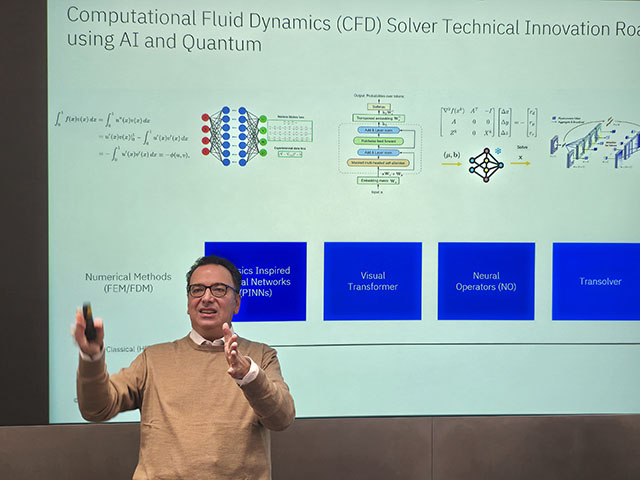
Curioni explained that historically, computing infrastructure has evolved through distinct eras. The early days were dominated by CPUs, which powered advances like computational fluid dynamics. This was followed by the rise of GPUs, which became central to high-performance systems and enabled breakthroughs in artificial intelligence. Now, he enthused, we are entering a new era of quantum-centric computing. He stressed that in this model, quantum processors will not replace classical systems but will become “the most valuable component of the computing stack,’’ enabling solutions to problems that were previously intractable – or that would otherwise take too long to be viable.
Curioni gave the example of computational fluid dynamics (CFD) using deep neural networks, and how quantum computing could reduce simulation times from weeks (using traditional models) to seconds (using quantum computing).
What was also important to note is how AI and quantum computing would work together. A key insight that I took away from the event was that together, artificial intelligence and quantum computing can create a synergy. While AI can make existing computational processes more effective, quantum computing can tackle entirely new classes of problems—those that are too complex or large-scale for classical computers. Additionally, quantum computing and AI together can leverage the best of each to tackle complex problems at scale. And, Curioni explained, some problems may never be addressed with classical solutions alone and will require quantum algorithms.
Heenthused that the combination of these technologies will not only increase the return on investment in computation but also unlock new use cases and applications across industries.
Quantum Valleys
But the impact of the rise of quantum computing is even more far reaching than solving previously unsolvable problems.
The shift to quantum-centric computing is expected to catalyze the emergence of new business ecosystems, much like classical computing gave rise to Silicon Valley. IBM foresees the creation of “quantum valleys,” which would be clusters of innovation and entrepreneurship built around quantum technologies and their applications.
Curioni and IBM envision that this ecosystem will foster the creation of new software businesses and drive value across sectors, much like it did fifty years ago when the personal computer became a reality and software, which then offered whole new ways to enhance productivity, fuelled the information age.
Quantum computing is coming
And, in November, three developments indicated that quantum computing is closer to fuller realization than before. Firstly, during November IBM unveiled fundamental progress on its path to delivering both quantum advantage by the end of the upcoming year and fault-tolerant quantum computing by 2029.
To this end, IBM unveiled Quantum Nighthawk, its most advanced quantum processor yet. This, the company explained, has been designed with an architecture to complement high-performing quantum software to deliver quantum advantage next year. What that means is that we will finally reach the point at which a quantum computer can solve a problem better than all classical-only methods.
Secondly, IBM announced IBM Quantum Loon, its experimental processor that, for the first time, shows that IBM has demonstrated all the key processor components needed for fault-tolerant quantum computing. IBM Loon will validate a new architecture to implement and scale the components needed for practical, high-efficiency quantum error correction.
The company explained that Quantum Loon is a milestone towards building the world’s first large-scale, fault-tolerant quantum computer before the decade concludes.
And the third development that demonstrates that Quantum Computing is closer than ever is the joint announcement by IBM and Cisco that they are developing a quantum internet.
On the horizon of possibility
While quantum computing is certainly on the horizons of the near future, the company noted that currently, only a handful of organizations worldwide can claim to operate true quantum computers; that is, systems with more than 100 qubits and error rates low enough that they cannot be simulated classically.
IBM is among this elite group, alongside a few others such as Google and the Chinese Academy of Science. Many other companies offer quantum devices for development or small-scale experiments, but only these leading organizations have reached the threshold of genuine quantum computation.
“There are many pillars to bringing truly useful quantum computing to the world,” said Jay Gambetta, Director of IBM Research and IBM Fellow. “We believe that IBM is the only company that is positioned to rapidly invent and scale quantum software, hardware, fabrication, and error correction to unlock transformative applications,’’ he added.
So what does this mean for those who don’t necessarily understand how quantum computing works, or why we should be excited about its rise? I
n essence, it means hope – the hope that along with AI, quantum computing represents the potential of taking a massive leap forward technologically. If you consider how much the personal computer, and traditional computing changed the world in the past fifty years, there is every indication that the growth of AI and quantum computing will change it even more exponentially in the next fifty.
Most Read Articles
 Acer Aspire Ultrabook S7 (i5)
 Data quality essential in training ChatGPT, says PBT Group
 Beats Pill XL
 Logitech Pebble 2 Combo
 Samsung Galaxy S4 Zoom - white
 Quick Review: Tecno Spark10 5G
 Samsung Galaxy S4 Zoom (black)


Have Your Say
What new tech or developments are you most anticipating this year?