Inside the Huawei Health and Fitness Lab: The science behind your smartwatch
By Mike Joubert 27 June 2025 | Categories: news.jpg)
Related Articles
 Core partners with local resellers to grow South A...
 Balancing AI and Human Rights in the modern workpl...
 How flexible ownership models are changing the SA ...
Arriving at the Huawei's Health and Fitness Lab in Dongguan, China, you make your way into the facility via a bright orange-coloured running track. In many ways, this is exactly how a journey into the testing hub of Huawei’s smartwatch and smartband sport technology should feel like - athletic and goal orientated.
As our guide takes us through the Health and Fitness Lab - one of three labs specifically meant for Huawei’s wearables (the others are located in Helsinki, Finland, and Xi'an, China) - you realise this is a serious sport zone meant for serious testing. Indeed, the latest Huawei Watch Fit 4 Pro can track over 100 different sports, with much of the testing and analysis behind its tracking being done here.
Here is a broader view of the #Huawei Health and Fitness Lab in Dongguan. Loads of zones for different types of fitness tracking analysis. pic.twitter.com/E9BHIU41lH
— TechSmart (@TechSmartZA) June 27, 2025
The facility actually encompasses most of the circular track, and in its centre is a large wooden court that can be used for different sports, including basketball (the backboards are lowered down from the ceiling), volleyball and badminton. The indoor rock climbing wall is difficult to miss, escalating its way up the one wall, next to a virtual shooting range and a workout area.
Run to your heart’s content
At the heart of the lab's mission is a deep dive into human physiology and biomechanics. Take for instance the Exercise Physiology Research and Testing Zone, where state-of-the-art treadmills, capable of speeds up to 40 km/h and slopes of 25%, are used to measure everything from maximum oxygen uptake (VO2 Max) to Metabolic Equivalents of Task (METs). This isn't just about recording a run, it's about understanding how the body performs at its peak, with data collected through respiratory metabolic gas analysers and heart rate monitors.
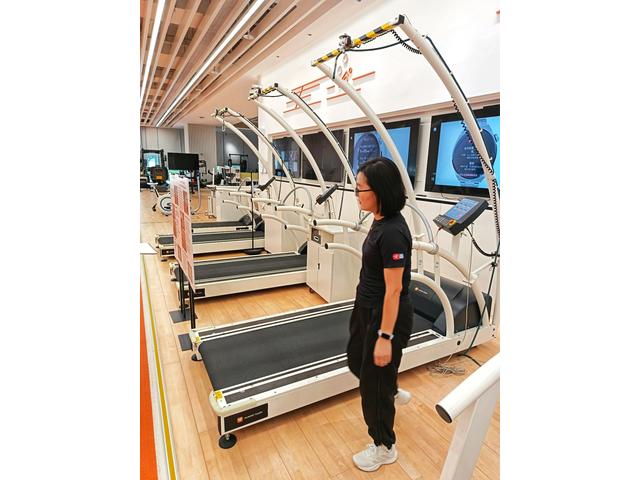
These state-of-the-art treadmills form the heart of the Exercise Physiology Research and Testing Zone
As a metric, V02 Max is highly important for runners, since this is the most common way fitness levels are measured. On a practical level, accurate measurements like these are crucial in a fitness orientated wearable. However, for Huawei the analysis doesn’t stop there, since certain athletes need even more in-depth data for top performance.
And it’s at the Gait Analysis Treadmill where Huawei receives granular insights into how we walk and run. Utilising high-precision force sensors, it measures dynamic and static pressure distribution on the soles of the feet, offering data on everything from foot rotation angle to stride length. This level of detail is invaluable for developing more accurate step tracking and potentially identifying gait issues.
If the Gait Analysis Treadmill is for specific data, the Multifunctional Motion Research Zone provides a broader overview. Here, a treadmill with a massive belt area (3500 x 2500 mm) supports speeds up to 50 km/h and incline adjustments from -4 to 12 degrees. Equipped with an emergency stop system, this facility allows for high-speed testing across activities like running, cycling, skiing and even skateboarding, with real-time physiological and motion posture data collection.

This is not an average treadmill you'll find in the gym
More sport, more data
Diving deeper into what the Health and Fitness Lab has to offer for swimmers, the Swimming Research and Testing Zone offers a unique glimpse into aquatic performance. The controlled flow pool, with adjustable temperatures from 5°C to 45°C, allows for simulations of real-world swimming conditions. Underwater camera systems capture intricate details like leg kick amplitude and arm stroke speed, feeding data into algorithms that aim to make swim tracking more precise than ever. Our touring party was also informed about the extra engineering that went into designing the sensors on the Huawei Watch Fit 4 for watersports. Since water flows between the sensor of the smartband and the skin, it makes accurate heart rate tracking more of a challenge.
The Body Composition Research and Testing Zone delves beyond simple weight, examining muscle mass, fat distribution and even hydration levels using advanced impedance-based analysers. In fact, it's here where a lot of the data for Huawei's TruSense body composition and analysis algorithm originates from. The lab's commitment to accuracy is evident in its use of industry-leading Inbody and TANITA devices for comparative testing, ensuring Huawei's own eight-electrode body fat scales provide data that correlates strongly with the "gold standard" DEXA scans. This also means your Huawei smart scale isn't just a gimmick, but a powerful tool for understanding your overall health.
Beyond endurance and composition, the lab also scrutinises athletic movements. The Motion Capture Research Zone, featuring a basketball court complete with a 3D motion capture system equipped with 28 discreet cameras, can capture movement at an astonishing 10 000 Hz. This level of detail allows researchers to analyse everything from stride length during a run to clubhead speed in a golf swing, providing critical data for optimising performance algorithms across various sports.
Inside #Huawei's Health and Fitness Lab in Dongguan, China, there's a Golf Research and Testing Zone. Here, high-speed cameras, projectors and 3D swing cameras work in concert to validate and optimise golf swing algorithms. pic.twitter.com/MHUQ56X43C
— TechSmart (@TechSmartZA) June 27, 2025
Speaking of which, with 15 000+ golf courses and swing analysis on the Watch Fit 4 Pro, golf enthusiasts might be particularly interested in the Golf Research and Testing Zone. Here high-speed cameras, projectors and 3D swing cameras work in concert to validate and optimise golf swing algorithms. The data collected, including upswing and downswing times, and swing rhythm, is crucial for refining the accuracy of wearable devices in tracking golf performance. And yes, hitting golf balls off a tee into a virtual course, with all data being captured by the Watch Fit 4 Pro (including swing tempo and swing speed) is as much fun as one can imagine.
Strength up the wall
Strength training, another cornerstone of fitness, is also studied here at the Health and Fitness Lab. The Strength Training Research Zone is equipped with a wide array of free weights and machines, allowing researchers to collect data on heart rate and energy expenditure during various exercises. This research directly informs how Huawei smartwatches can better monitor and guide users through their strength routines.
.jpg)
Even niche activities like rock climbing are covered. The Rock Climbing Research Zone features an artificial climbing wall soaring 10.5 meters high, offering various routes for analysis. Huawei wearables worn by climbers track heart rate and energy expenditure, contributing to the development of tailored training regimens.
In essence, the Huawei Health and Fitness Lab is a testament to the rigorous scientific methodology underpinning the development of their wearable technology. By dissecting human movement and physiology with such precision, it certainly looks like Huawei aims to ensure that your smartwatch or smartband isn't just a gadget, but a sophisticated personal trainer and health monitor, backed by robust research and designed to help you achieve your fitness goals.
Most Read Articles
-2.jpg) SA healthcare braces to take on risk
SA healthcare braces to take on risk Movie Review: Kick-Ass 2
 Monster NCredible N-Tune headphones
 All Conquering SUVs


Have Your Say
What new tech or developments are you most anticipating this year?