LG’s plan to take the smart home from the kitchen to the factory floor
By Industry Contributor 16 November 2026 | Categories: feature articles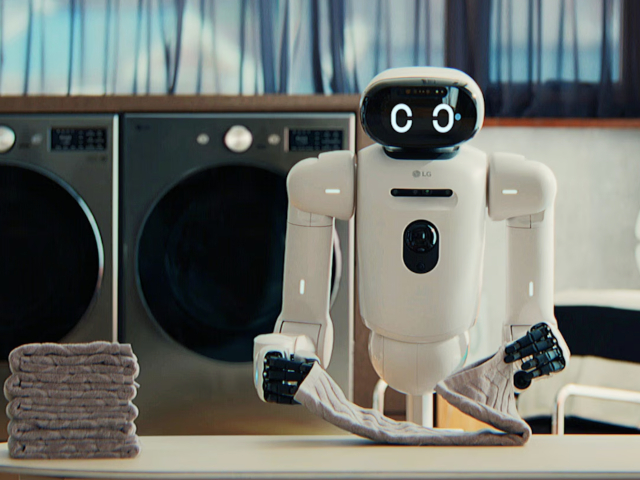
Related Articles
 Who's watching the agents you've already built?

 The industry providers aimed to automate everythin...
 Before an AI agent gets authority, make it pass a ...
Is a smart home smart enough? What about one that learns your habits, cares for itself, manages apartment blocks and even folds the laundry? Tiana Cline visited LG Electronics in Seoul, South Korea, to find out.
For most people, the smart home has meant one more app to manage. A fridge that can be adjusted from a phone is connected, but it still sits and waits to be told what to do. LG Electronics wants to change that, moving its smart home strategy past simple connectivity to an AI Home ecosystem that learns how a household lives and adjusts around it.
“Simply connecting devices wasn’t enough, because it wasn’t that different from the smart homes we already know,” says Ju-hyun Kang, HS Brand Marketing at LG, speaking during a media tour at LG Science Park in Magok, Seoul. LG’s AI Home is built on four values of comfort built on trust, visible convenience, open access and growing together. Practically speaking, that means three things – appliances get smarter, LG's ThinQ smart home platform ties them together and, eventually, robots do the work. “The first smart home is connectivity. The second stage is smart routines. The next stage is understanding you,” explains Je-won Park, LG's AI Home Solution Biz.
What an AI home looks like today
LG’s clearest demonstration of the idea sits on the first floor of LG Science Park. ThinQ Real was originally a research facility where new appliances were tested in recreated living spaces, and it has since been turned into a 100-square-metre home with an open-plan living, dining and kitchen area, a bedroom and a laundry room. When a user unlocks the front door with a fingerprint, the home might suggest using the LG Styler (an at-home steam closet) because fine dust levels outside were high that day, while the living room lights warm up and their favourite music starts playing.
Ask LG's AI-powered smart home hub, ThinQ ON, how to make chicken breasts and it walks through the recipe for the oven, then opens nearby windows and switches on the range hood as soon as the oven starts. Saying ‘I’m going out’ switches off the lights, puts the appliances into power-saving mode, checks the electric vehicle’s battery level and sends the robot vacuum out to clean. LG calls this the Zero Labor Home, and ThinQ Real is its way of showing that this such a far-off concept.
Appliances that learn from the inside
The smarts start in the hardware. LG’s AI Core Tech applies AI to the motors, compressors and inverters that determine how well an appliance performs, so a washing machine reads fabric and soil levels and checks them against 20 000 patterns before it picks a cycle. A refrigerator spends three weeks learning when the door tends to open and starts cooling before the rush. “Visible convenience means benefits you can feel in your daily life, such as saving time, energy and money,” says Kang.
And then there’s ThinQ ON, which learns a household’s routines and takes instructions in plain conversation. On the platform side, ThinQ UP adds features after purchase and ThinQ Care tracks usage and product condition, raising an alert before a fault turns into a breakdown. One recent update lets a household set a monthly energy limit, with the appliances adjusting how they run to stay within it. “Customers choose what they need, and over time appliances adapt to their lifestyle, becoming more personal and more valuable,” adds Kang.
Opening up to other brands and businesses
LG knows most homes aren’t filled with one brand. Its acquisition of Athom, the Dutch company behind the Homey platform, means LG AI Home now supports more than 200 brands, 1 000 services and over 50 000 devices. “We are delivering global top-tier connectivity that goes beyond LG products, and we keep expanding it,” Kang says.
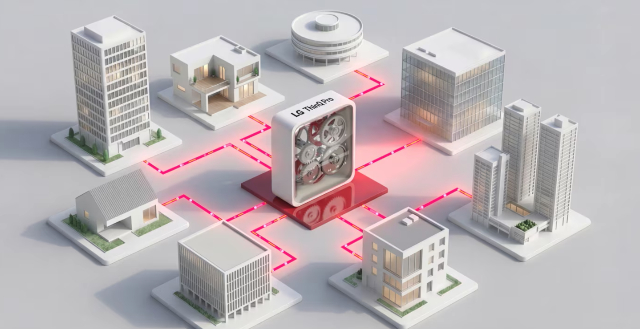
A visual illustration of LG's ThinkQ Pro
The bigger opportunity may be B2B. ThinQ Pro, a dedicated platform for property managers and large residential complexes, lets operators register every appliance in a unit with a single QR scan, monitor status and maintenance from one dashboard, and manage energy use unit by unit. Because it links connected appliances with HVAC systems, it can also alert building managers to risks such as a leaking washing machine or a blocked dryer duct. LG says it connects to existing operational systems through tailored consulting, so property groups don’t have to rip out the platforms they already run. ThinQ Pro was launched for North American builders at the Kitchen and Bath Industry Show held in Orlando, Florida in February, and made its European debut at IFA in Berlin in September, where LG pitched it for commercial spaces as well as apartment blocks.
Physical AI and the home robot
One of the most interesting pieces of the ‘smart home’ LG talks about is physical AI. And in this scenario, it’s a home robot named CLOiD that the company unveiled at CES back in January. CLOiD has a head unit, two articulated arms with five-fingered hands and a wheeled base that borrows its navigation from LG’s robot vacuums. It works with ThinQ and ThinQ ON to orchestrate the appliances around it and at CES it took milk out of the fridge, put a croissant in the oven and then folded the laundry after drying.
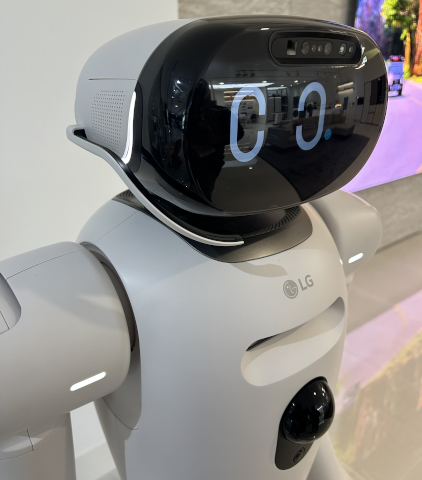
LG's CLOiD home robot
“CLOiD understands situations through vision, decides what to do and takes action autonomously,” says Kang. For now, the home robot is learning factory work too. In August, LG said it had deployed CLOiD robots at scale in its new Data Factory at the Yangjae R&D campus in Seoul. One space replicates a home, where the robots practise cleaning tasks on repeat, while another is modelled on LG’s washing machine plant in Tennessee, where they move, stack and assemble parts. LG expects the facility to have generated 100 000 hours of training data by the end of the year, roughly 12 years’ worth. There is no word yet on pricing or when CLOiD will be commercially available.
“LG will continue to introduce robots with diverse mobility and new form factors, and these next-generation robots will extend beyond the home to industrial and commercial environments,” ends Kang.
Most Read Articles
 LG’s plan to take the smart home from the kitchen to the factory floor
 Samsung Galaxy S4 Zoom - white
 Audi's Traffic Lights tricks now also heading to Europe
-2.jpg) CSSi’s green practices secure off-grid data centre gold at the Data Centre Wor...



Have Your Say
What new tech or developments are you most anticipating this year?